Men's Style
Coat vent tacking stitch: what to cut and what to leave
That small cross of thread on your new coat is there for transport, not tailoring. Here’s how to remove it without damaging the garment.

By James Whitaker, Editor
Published · 6 min read
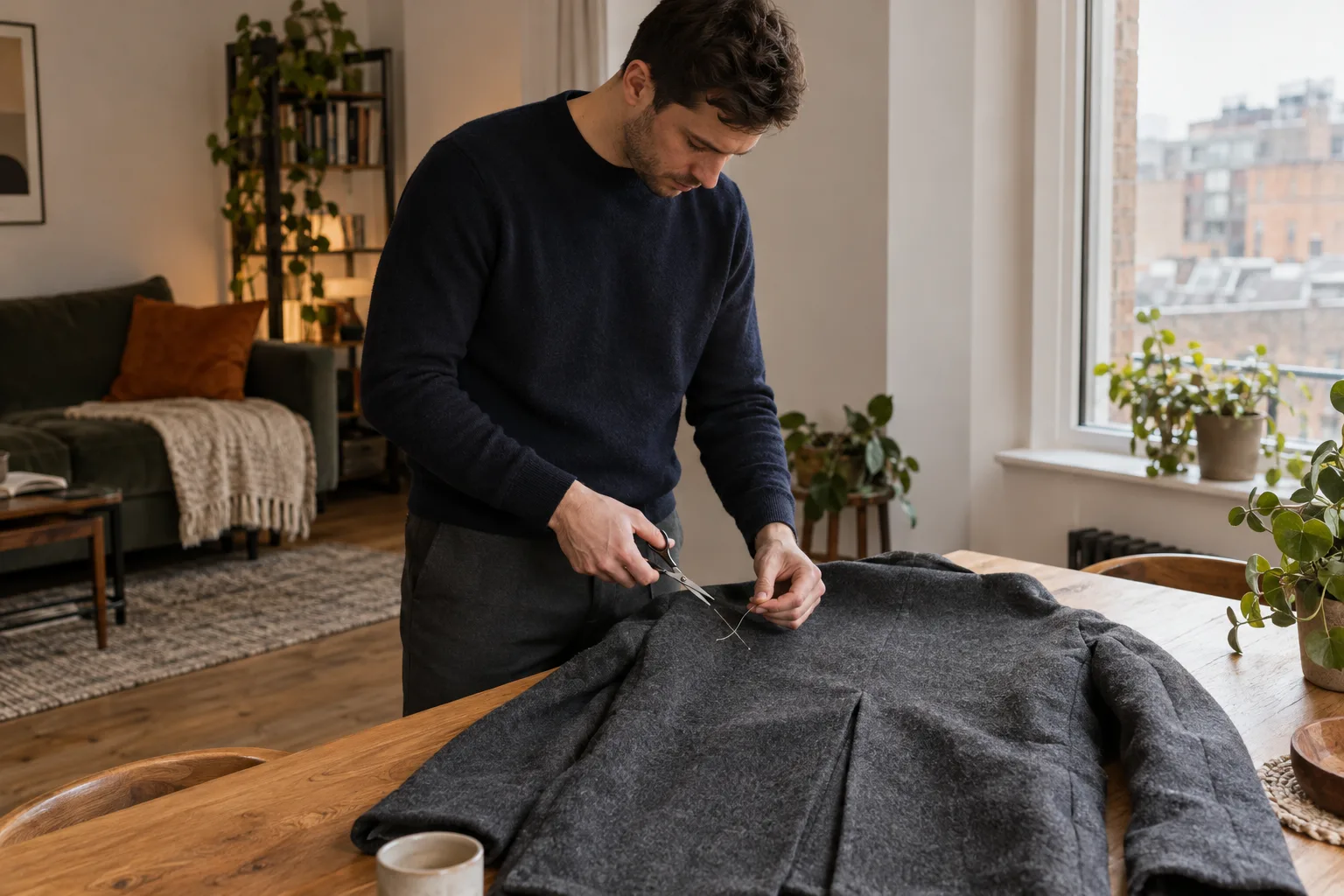
Quick answerRemove the temporary tacking stitch holding a new coat’s back vent closed before wearing it. Snip only the loose thread bridging the opening, then gently pull it free; leave the permanent stitching around the vent intact.
A new coat can be the right size and still pull awkwardly at the back if its vent remains stitched shut. The culprit may be a small piece of temporary thread, often arranged in an X, holding together an opening that is supposed to move. It belongs to the garment’s journey to the shop, not its working life in your wardrobe.
The useful distinction is between removing that temporary fastening and unpicking the coat itself. One is a straightforward finishing job; the other can damage the garment. Before reaching for scissors, identify exactly what the thread connects. Here’s what deserves the snip — and what absolutely does not.
What happened
The issue concerns a standard preparation step on some new overcoats, suit jackets and blazers: removing the temporary stitches across their rear vents. These stitches help prevent the overlapping sections from shifting and creasing while garments are transported and displayed. Once the coat is ready to wear, that particular job is finished.
A vent is the opening rising from the garment’s lower edge, usually at the back. Holding it closed limits the movement built into the cut. As you walk or sit, the fabric below your waist needs room to separate rather than being tethered at one point.
That does not mean every coat leaves the shop with an obvious contrasting cross. The thread may blend into the cloth, and the temporary stitching may look less conspicuous than an X. Its position and function matter more than its colour: look for a loose fastening that bridges the intended opening.
This is worth checking before deciding a new purchase needs alterations. A closed vent can interfere with how the lower section hangs, although releasing it cannot correct tight shoulders, a restrictive chest or insufficient room through the hips. Those are separate fit questions.
If you’re weighing up the shapes in our autumn/winter 2026 menswear guide, assess the coat as a complete garment: shoulder position, room for layers and the way the hem moves. Temporary packaging stitches should not be mistaken for part of the silhouette.
The background
Why the opening matters
Tailored jackets commonly have a single central vent, two side vents or no vent at all. A single vent divides the lower back at the centre; double vents create a separate rear panel between two openings. A ventless jacket has no such split. There is nothing to release where the design provides no opening.
Overcoats can use the same basic principle on a longer garment. An overlap allows the fabric to sit neatly when you are standing while giving it space to move with your stride. Removing a temporary tack does not mean the vent must gape open: the cloth should still settle according to the cut.
The distinction is particularly useful with formal clothing, where unfamiliar details can look like rules you ought not to question. Our guide to morning dress covers the broader dress code; for any individual garment, construction still needs to be distinguished from temporary shop preparation.
Not all visible thread is disposable
Permanent stitching finishes the vent’s edges and secures its upper end. A short, dense line of reinforcement at the top is not the same thing as a loose thread spanning the opening. Removing structural stitches can weaken the area or open a seam. If you cannot clearly separate the two, stop.
Pocket openings are another possible source of confusion. They may also arrive loosely stitched closed, but they are not vent tacks and should be assessed separately. Some apparent pockets are decorative rather than functional. Check that a pocket bag exists and ask the retailer if its construction is unclear; a closed line of fabric is not an automatic invitation to cut.
What people are saying
Our view is simple: remove confirmed temporary vent tacking, but skip the embarrassment routine. A man wearing a stitched-up coat has missed an unhelpfully discreet preparation detail, not failed an entrance exam. The useful style advice is to explain the thread’s purpose and show where it ends.
We also would not use an open vent as proof that a coat fits properly. If the fabric above it pulls into pronounced tension lines, or the opening splays while you stand naturally, the fit deserves a closer look. Ask a tailor to assess it with the layers you actually plan to wear underneath.
There is a related detail on some tailored sleeves: a lightly attached maker’s label intended for removal after purchase. That is different from an intentionally permanent logo patch. Inspect how it is attached, or ask the shop, rather than assuming every visible label should go. Tugging off even a temporary label can leave damaged cloth behind.
We rate this sort of wardrobe housekeeping because it restores the design rather than adding decoration. It is also a useful buying principle: learn what a detail does before treating it as a status signal. Our advice on choosing a cologne without buying into a personality applies that same practical thinking to fragrance.
What happens next
Remove the tack without touching the cloth
Start with the coat off your body and supported on a clear surface. Spread out the lower back so you can see both sides of the vent. Good visibility matters more than speed, particularly with dark thread on dark fabric. Avoid working with the coat bunched in your lap.
Follow this sequence:
- Locate the temporary fastening. Trace the loose thread across the overlapping vent sections. Make sure it is not part of the stitched edge, lining attachment or reinforcement at the top.
- Separate thread from fabric. Gently lift a small section with your fingers so there is a visible gap beneath it. Do not pull hard enough to strain the cloth.
- Make a controlled cut. Use small scissors to snip the isolated thread, keeping the blades away from the coat. A seam ripper is an alternative if you know how to handle one safely.
- Withdraw the loose ends. Ease the thread out from each side. If it catches, inspect the remaining stitches rather than yanking. Another small snip may be needed.
- Check the opening. Remove stray pieces of thread and let the overlapping sections settle. There is no need to cut into the seam to make the vent longer.
For a double-vented jacket, inspect both openings rather than assuming there is only one tack to remove. With delicate, loosely woven or expensive cloth, asking the retailer or an alterations tailor to do the job is a sensible precaution. Scissors are not a compulsory test of self-reliance.
Check the result in use
Put the garment on over your usual outfit, then walk and sit down. Look for comfortable movement rather than a dramatically different shape. If the vent still appears attached somewhere, take the coat off and inspect it again; do not force the panels apart while wearing it.
If you are still deciding whether to keep a purchase, check the seller’s returns conditions before removing stitches or labels. Once you have committed to it, make this inspection part of getting the garment ready. Any stitching whose purpose remains uncertain can wait for someone qualified to identify it.
Related: Unusual watches: when telling the time becomes a design choice
Why this matters
For UK readers buying a coat to wear over office tailoring or winter knitwear, this is a useful check before paying for adjustments. Bring your usual layers to a fitting and ask the retailer to identify any temporary vent stitches before you leave. You’ll be assessing the garment as it is meant to function, rather than compensating for a closed opening. When considering the cuts in our autumn/winter menswear guide, remember that freedom to move is part of fit, not an optional extra.
Common questions
- should i remove the X stitch on my coat?
- Yes, if it is the temporary thread holding the back vent closed. It keeps the garment tidy during shipping and display, but should be removed before wear. Leave the permanent stitching around the opening alone.
- why are coat vents sewn shut?
- Temporary stitching helps keep the overlapping vent sections in place during transport and shop display. The vent is intended to move once the coat is being worn.
- how do i remove a coat vent tacking stitch?
- Lift the loose thread clear of the fabric, snip it carefully with small scissors and gently withdraw the ends. Work with the coat off your body. If the thread resists, inspect it rather than pulling harder.
- do i cut the stitches on the back of a suit jacket?
- Cut only confirmed temporary stitches bridging the vent openings. Suit jackets and blazers can have the same removable tacking as overcoats. Do not cut the finished edges or reinforcement at the top of a vent.
- will removing the vent stitch fix a tight coat?
- It can release movement restricted by the closed vent, but it cannot fix an incorrectly sized coat. Tight shoulders, a restrictive chest or insufficient room through the hips need a separate fit assessment.
- should i remove the label on my jacket sleeve?
- Remove a lightly attached maker’s label intended only for shop display, but not an intentionally permanent logo patch. Ask the retailer if you are unsure, and never tear a label off the fabric.
- should i cut open sewn coat pockets?
- Only after confirming they are functional pockets with temporary closure stitches. Pocket stitching is separate from vent tacking, and some apparent pockets are decorative. Ask the retailer if you cannot identify the construction.
About the writer
James WhitakerEditor · London
Editor of The Good Cut, with a soft spot for a sharp crop and a sharper suit.
More from JamesSources
This article is original reporting by The Good Cut based on the sources above. Last reviewed 8 October 2026. Product mentions are editorial unless clearly marked as sponsored.