Men's Style
Morning dress explained: what to wear and what to skip
From wedding invitations to race-day rules, here’s how to get morning dress right without looking as though you’ve raided the costume department.

By Priya Nair, Style Editor
Published · 6 min read
Quick answerMorning dress is traditional formal daytime clothing: a morning coat, waistcoat, formal trousers, collared shirt, tie and black shoes. It is worn for occasions such as formal weddings and certain race-day enclosures, rather than as a substitute for evening black tie.
Morning dress on an invitation calls for something more specific than your smartest office suit. The traditional daytime dress code centres on a cutaway coat and waistcoat, with formal weddings and certain race-day settings among its familiar British uses. A dinner jacket belongs to a different category: evening wear.
Gentleman’s Gazette’s morning-wear guide sets out the distinctions, including one easily missed point: a matching grey morning suit is not the most formal version. For anyone hiring wedding clothes or decoding an enclosure’s requirements, the useful question is not simply how smart an outfit looks, but whether its parts belong together.
What happened
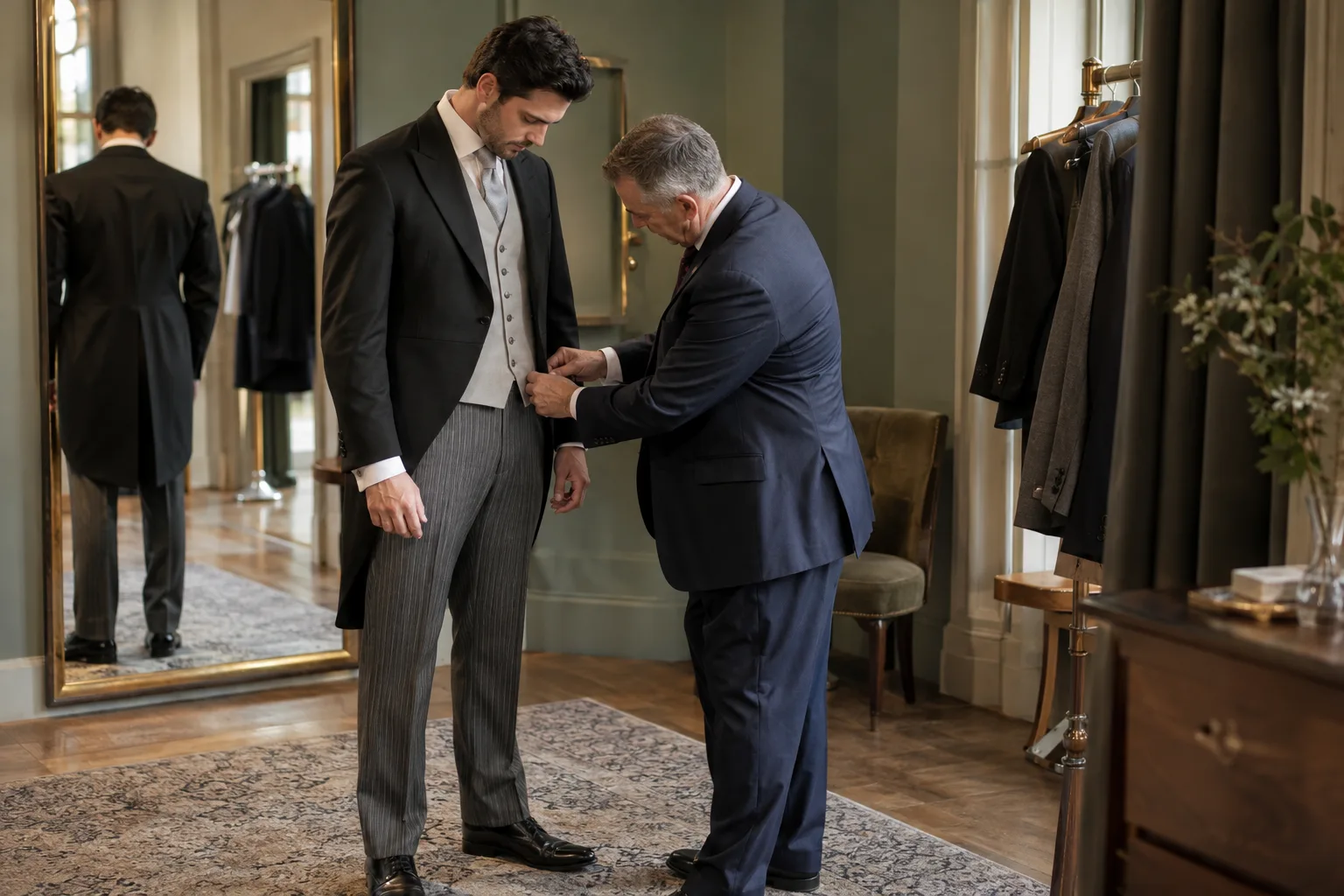
This is an established etiquette guide, not an announcement of new rules. Its practical value lies in separating garments that hire rails and wedding mood boards can blur together. According to Gentleman’s Gazette, traditional formal morning dress pairs a black or dark-grey morning coat with contrasting trousers and a waistcoat. Black is the most formal coat colour.
Start with the silhouette
The coat is single-breasted, with peaked lapels and fronts that curve away towards long tails behind the legs. That cut distinguishes it from both a conventional lounge jacket and an evening tailcoat. Wool is traditional, with plain cloth and herringbone among the options described in the guide.
For the most formal trouser choice, look for dark grey with black stripes. Checked patterns, including houndstooth and glen check, sit further down the formality scale. The hems should have no turn-ups. More importantly, the trousers need enough rise for the waistcoat to cover the waistband: a strip of visible shirt between the two breaks the outfit’s line.
A useful fitting-room test is to sit down, stand up and move your arms while wearing the complete outfit. Braces can support trousers cut for them, but they cannot rescue the wrong rise. Ask the fitter to assess coat, waistcoat and trousers together rather than treating each garment as a separate purchase.
The same joined-up approach applies above the collar. You do not need a particular haircut for morning dress; tidy edges and a shape you recognise as your own are enough. If you are already considering going shorter, our guide to buzz-cut lengths and what to ask your barber explains the choices. Formal clothes are no reason to gamble on an unfamiliar cut.
The background
The word “morning” is slightly misleading: this dress code covers formal afternoon occasions too. It describes a category of daytime clothing, not a requirement to finish wearing it before lunch. For a wedding continuing into the evening, follow the couple’s instructions rather than assuming that sunset creates an automatic outfit change.
There is also a technical distinction between morning dress and a morning suit. Gentleman’s Gazette uses the latter for a coat, waistcoat and trousers made from the same light- or mid-grey cloth. That coordinated version is traditionally less formal than the contrasting ensemble and is associated with summer weddings and the races. In everyday conversation, the terms are often used interchangeably; when booking a hire appointment, describe the garments rather than relying on the label.
The shirt and tie are a partnership
A turn-down collar is the normal modern choice. A white shirt is straightforward, while a pale or subtly patterned body with a white collar offers another traditional route. Double cuffs take cufflinks, so remember to include them when assembling the outfit rather than discovering two open cuffs on the morning itself.
With that collar, wear a conventional tie. Silver or pale grey with a discreet black pattern is particularly traditional; pastel colours are another option. The guide advises maintaining contrast with the shirt. A pale-blue tie against an almost identical blue shirt can lose definition, whereas a white collar gives the knot a clearer boundary.
The historical-looking alternative is more specific than simply adding a cravat. The guide pairs a high, stiff, detachable white wing collar with a self-tied formal dress cravat and a black morning coat. A casual cravat tucked inside an open shirt is a different garment arrangement entirely. Do not confuse relaxed neckwear with ceremonial dress just because both involve extra fabric.
What people are saying
The clearest distinction in the supplied guidance is between established convention and personal choice. Gentleman’s Gazette allows colour through waistcoats, shirts and ties while retaining a recognisable structure. That is useful permission for men who associate formal dress with wearing exactly what everybody else has hired. A pale waistcoat is within the tradition, not a rebellion against it.
Waistcoats can be single- or double-breasted, with dove grey and buff among the classic colours. The guide also summarises Debrett’s position that black waistcoats are now associated with mourning and certain daytime London functions. For a celebratory wedding, grey or buff is therefore a more straightforward starting point than assuming that maximum black means maximum correctness.
Our recommendation is to choose one area for colour rather than making every accessory compete. A softly coloured waistcoat can do the work while the tie stays restrained. This is styling advice, not an additional etiquette rule: the aim is to make the coat’s shape and the shirt’s collar readable, rather than turn the chest into a fabric-swatch display.
Shoes demand less interpretation. The guide specifies well-polished black lace-ups with plain or capped toes. Check their condition before the event, including the heels and laces, and wear socks long enough to avoid exposing your calves when seated. An expensive coat cannot make neglected footwear disappear.
Fragrance is another area where restraint is practical, especially at close quarters during a ceremony or meal. Apply a familiar scent sparingly rather than making the occasion a test run. Our guide to choosing a cologne without buying into a personality takes the same approach: pick what suits you, not an invented formalwear alter ego.
What happens next
Before buying or hiring anything, check the actual invitation and, for racing, the rules for your specific enclosure. Gentleman’s Gazette identifies a top hat as obligatory in Royal Ascot’s Royal Enclosure, but that does not make one compulsory at every wedding or across every part of the racecourse. Consult the organiser’s current requirements; a general guide is not an admission policy.
Make the fitting do some work
Take the shirt and shoes you intend to wear to the appointment. The shirt affects how the collar and cuffs sit beneath the coat, while the shoes help the fitter judge trouser length. If hiring, establish what is included, when collection and return are due, and whether adjustments can be made before you leave with the outfit.
Separate essentials from optional extras. Cufflinks serve a purpose with double cuffs; a pocket watch, cane and gloves are not universal requirements. A white linen pocket square or wedding buttonhole can provide a finishing detail without requiring the full ceremonial inventory. Check with the couple before arranging your own buttonhole if flowers are being supplied.
Finally, plan grooming around what you already wear comfortably. If that means stubble rather than a clean shave, our guide to getting a controlled five-o’clock shadow covers the preparation. Leave time to dress, tie the knot yourself and inspect the outfit from the side as well as the front. The morning coat’s long back is part of the fit, not an afterthought.
Related: Autumn/winter 2026 menswear trends: what’s worth wearing
Why this matters
For UK readers, the expensive mistake is treating every formal invitation as a reason to buy another suit. Establish the exact dress code first, then decide whether hiring makes more sense for your likely use. Spend fitting time on the waistcoat-to-trouser join and the coat’s proportions, rather than collecting optional accessories. If you wear a beard, a quick tidy with an appropriate tool matters more than changing your whole look; our guide to choosing a beard comb explains what to consider.
Common questions
- what is morning dress for men?
- Morning dress is traditional formal daytime attire built around a cutaway morning coat, waistcoat and formal trousers. It is completed with a collared shirt, appropriate neckwear and polished black shoes.
- can you wear morning dress in the afternoon?
- Yes, morning dress is appropriate for formal afternoon events as well as morning occasions. For weddings continuing into the evening, follow the couple’s dress instructions.
- what is the difference between morning dress and a morning suit?
- Strictly speaking, a morning suit has a matching light- or mid-grey coat, waistcoat and trousers. Traditional formal morning dress uses contrasting pieces, although people often use the two terms interchangeably.
- do you need a top hat with morning dress?
- Not for every occasion. A top hat is required in Royal Ascot’s Royal Enclosure, but wedding requirements vary. Check the invitation or the organiser’s current rules.
- what shoes do you wear with morning dress?
- Wear well-polished black lace-up shoes with plain or capped toes. Choose socks long enough to keep your calves covered when you sit down.
- do you wear a tie or cravat with morning dress?
- A conventional tie with a turn-down collar is the straightforward modern option. The traditional formal cravat arrangement uses a stiff, detachable wing collar; an informal cravat inside an open shirt is not equivalent.
- should morning dress trousers have turn-ups?
- No, formal morning trousers should have plain hems without turn-ups. They should also sit high enough for the waistcoat to cover their waistband.
About the writer
Priya NairStyle Editor · London
Seasonal style, smart buys and the trends worth your money.
More from PriyaSources
This article is original reporting by The Good Cut based on the sources above. Last reviewed 8 October 2026. Product mentions are editorial unless clearly marked as sponsored.