Men's Style
Patek Philippe Watch Art in Milan: what’s worth seeing
Free entry, intricate mechanics and some unusually bold dials: Patek Philippe’s Milan exhibition offers more than a parade of expensive wristwear.
By The Good Cut Editorial Team
Published · 6 min read
Quick answerPatek Philippe Watch Art runs from 2–18 October 2026 at CityOval in Milan. Admission is free with reserved tickets, with historic watches, the current collection and special Milan editions giving visitors a close look at mechanical watchmaking and decorative crafts.
Timeline
2012
Dubai hosts the first edition of Patek Philippe’s grand exhibition series.
2013
The exhibition moves to Munich for its second edition.
2015
London hosts the third grand exhibition.
2017
New York becomes the series’ fourth host city.
2019
The fifth grand exhibition takes place in Singapore.
2023
Tokyo hosts the sixth edition.
2–18 October 2026
Milan’s CityOval hosts the seventh edition, with free admission and reserved tickets.
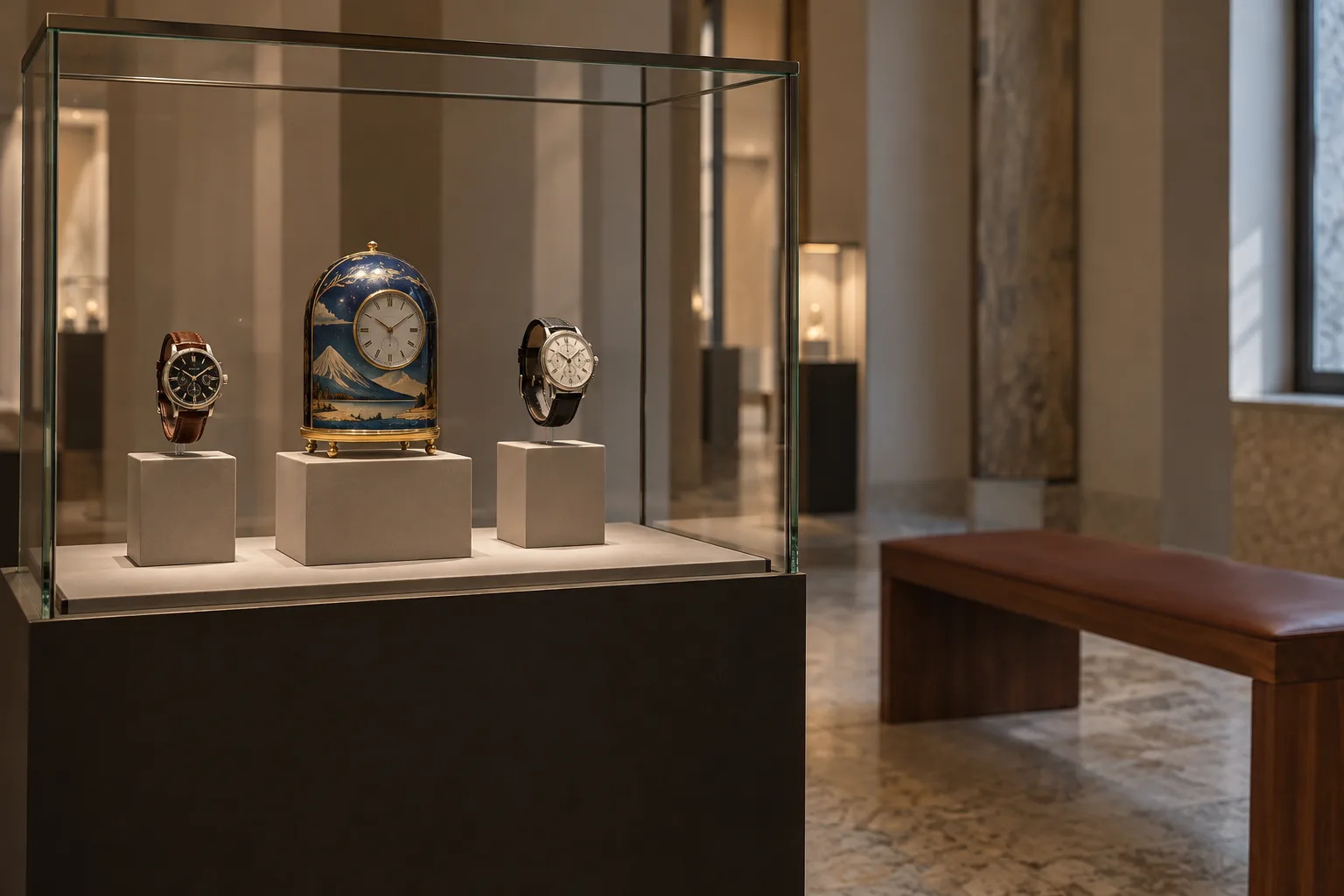
Patek Philippe’s Watch Art Grand Exhibition brings a substantial slice of Geneva watchmaking to Milan from 2–18 October 2026, with free admission for visitors who reserve tickets. The venue is CityOval, formerly Palazzo delle Scintille, on Piazza Sei Febbraio. Inside, historic pieces sit alongside the current collection and watches created specifically for the Milan event.
Our reason to go is not the prospect of finding your next purchase. It is the chance to understand what makes a mechanical watch interesting before prices, waiting lists and resale chatter take over. A decorated desk clock can teach you as much about craftsmanship as a complicated wristwatch — and neither requires a conversation about your bank balance.
What happened
Milan is the seventh stop in Patek Philippe’s grand exhibition series. This edition brings together more than 500 historic pieces from its Geneva museum archive and the entire current catalogue, giving visitors a much broader view than a boutique window can offer. It also includes 25 Rare Handcrafts models across wristwatch, pocket-watch and domed desk-clock formats.
Those different formats matter. A wristwatch compresses its decorative work into something small enough to disappear beneath a cuff; a domed clock gives the same disciplines a larger surface. Look for enamel, patterned engraving known as guilloché, wood marquetry and engraved casework. They involve different materials and skills, rather than interchangeable ways of making an object look expensive.
Our first stop would be the World Time Minute Repeater pair. References 5531G-012 and 5531G-013 depict central Milan in cloisonné enamel, one by day and the other by night. Fine wires divide the enamel into separate areas, allowing the dial to carry a miniature scene. The location is part of the watch’s construction and decoration, not simply a city name added to its face.
Elsewhere, colour does much of the talking. The Aquanaut Ref. 5167 combines a cobalt-blue sunburst dial, a dark gradient and a red minute track. The Ref. 7147G-010 perpetual calendar uses an emerald-green dial and strap, with Italian day and month indications. These are useful details to compare: one watch builds contrast, while the other commits to a single dominant colour.
For anyone drawn to watches as designed objects rather than status signals, our guide to unusual watches and their different approaches to telling the time offers another way into the subject. Milan adds a particularly elaborate decorative dimension.
The background
The grand exhibition series began in Dubai in 2012, followed by Munich, London, New York, Singapore and Tokyo. Those six editions attracted roughly 225,000 visitors combined. Milan therefore belongs to an established public-facing programme, rather than being a one-off launch event with a few museum pieces borrowed for atmosphere.
Patek Philippe’s use of travelling exhibitions stretches further back, including presentations during the 1970s. That decade sits within the quartz crisis: the upheaval caused as accurate, battery-powered quartz watches challenged the established mechanical watch industry. Mechanical watchmaking subsequently found renewed appeal through engineering, finishing, heritage and collectability, rather than by winning a straightforward contest over everyday accuracy.
That distinction remains useful when looking around an exhibition like this. A mechanical movement stores energy in a wound spring and releases it through a regulating mechanism. The interest lies in how that system is constructed and what else it can do. A more complicated mechanism is not automatically a more practical watch for your commute.
A perpetual calendar, for example, is designed to account for different month lengths and leap years when correctly set and kept running. A chronograph measures elapsed time. A minute repeater sounds the time on demand. Patek’s Milan line-up includes the Ref. 5978P-010, combining an instantaneous perpetual calendar with a chronograph and window-based calendar displays.
Knowing those distinctions makes the display less intimidating. It also sharpens your judgement elsewhere: as our look at motorsport watches and what merits your money explores, a watch’s sporting associations and its usefulness are separate questions. The same applies to an exhibition edition’s rarity and its appeal on your wrist.
What people are saying
Our take is that the most persuasive part of this exhibition is the decorative work, not the scarcity. Limited production can make something harder to obtain; it cannot, on its own, make a dial more beautiful or easier to read. The enamel cityscapes give you something specific to examine and judge without needing a collector’s backstory.
The green perpetual calendar is our style pick. A matching dial and strap create a coherent block of colour, while the calendar indications provide detail at closer range. We would wear that approach with a navy jacket, grey knitwear or a plain white shirt, keeping the surrounding clothes quiet. You can borrow the principle without buying the watch.
The red-dial Ref. 7047G-010 minute repeater takes a louder route, pairing its lacquered face with a matching alligator strap. Our advice would be to let that red remain the outfit’s single strong accent. Adding red shoes, a red belt and a matching pocket square would turn a considered choice into a uniform nobody requested.
At the other end of the palette, the Calatrava Ref. 7007G-010 has a white dial and matching strap. We rate the visual simplicity, but colour does not establish durability. A pale strap makes marks more conspicuous, and a sporty-looking watch should never be assumed suitable for swimming. Water resistance and care instructions belong to the individual reference, not its appearance.
For a wider wardrobe perspective, our assessment of autumn/winter 2026 menswear trends worth wearing provides a useful companion. Here, the transferable lesson is proportion: the watch can supply the colour or visual detail, leaving your clothes to provide a calmer frame.
There is also a limit to what we would infer from an exhibition display. Looking through glass can reveal layout, colour and decorative detail, but it cannot establish how a case sits on your wrist or whether its weight suits you. Admiration and a buying recommendation are different things.
What happens next
If you are planning a visit, secure your exhibition reservation before building a trip around it. Free admission does not remove the need for a ticket, and the closing date is 18 October. Check the booking information for available slots and access arrangements before committing to transport or accommodation.
Rather than attempting to memorise every reference, choose three things to investigate: a mechanism, a decorative technique and a design decision. You might compare calendar displays, study the wire divisions in cloisonné enamel, then look at how a coloured minute track changes a dial. That gives a large exhibition a manageable shape.
Pay attention to legibility, too. Find the hour and minute hands first, then work out which indications you would actually use. Decorative complexity and functional clarity can coexist, but not every arrangement will suit your eyes. That is a perfectly sound reason to prefer the less elaborate watch in a cabinet.
If the visit eventually leads to shopping, separate the exhibition excitement from ownership. Ask about servicing, strap replacement, water resistance and the correct procedure for adjusting complications. For now, the strongest proposition is simpler: access to an unusually broad watchmaking display without needing to become a customer. Go to look closely, not to prove you belong.
Why this matters
For UK readers considering an autumn trip to Milan, this is a free cultural stop with a practical menswear dividend: a better eye for detail. Compare colours, read the dials and notice which designs still appeal once their complexity stops being the main attraction. Back home, apply that judgement to any budget, alongside the questions in our guide to motorsport watches and buying value. The useful souvenir is knowing what you like, rather than knowing which reference is hardest to obtain.
Common questions
- when is Patek Philippe Watch Art in Milan?
- Patek Philippe Watch Art runs from 2–18 October 2026. Milan hosts the seventh edition of the brand’s grand exhibition series.
- is the Patek Philippe Milan exhibition free?
- Yes, admission is free, but visitors need reserved tickets. Secure a reservation before committing to travel specifically for the exhibition.
- where is Patek Philippe Watch Art in Milan?
- The exhibition takes place at CityOval, formerly Palazzo delle Scintille, on Piazza Sei Febbraio in Milan.
- what can you see at Patek Philippe Watch Art?
- The display includes more than 500 historic pieces from the Geneva museum archive, the current collection and special Milan editions. There are also 25 Rare Handcrafts models, including wristwatches, pocket watches and domed desk clocks.
- which Patek Philippe watches have Milan on the dial?
- World Time Minute Repeater references 5531G-012 and 5531G-013 depict central Milan in cloisonné enamel. The first shows the city by day; the second depicts it at night.
- what is a minute repeater watch?
- A minute repeater is a watch that sounds the time on demand. It is a mechanical complication, distinct from a chronograph, which measures elapsed time.
- what is cloisonné enamel on a watch?
- Cloisonné enamel uses fine wires to divide a surface into areas filled with enamel. On the Milan World Time Minute Repeaters, the technique creates miniature city scenes within the dials.
Sources
This article was written by The Good Cut using the sources listed above. Product mentions are editorial unless clearly marked as sponsored.